

Capacity Building for Health Departments
CPHI has partnered with several national partners - including the National Association of County and City Health Officials, the Council of State and Territorial Epidemiologists, and the Centers for Disease Control's Agency for Toxic Substances and Disease Registry - to advance multiple initiatives that strengthen the capacity of state and local health departments. Read more about these projects below.
.png)
Maternal Child Health and Emergency Preparedness and Response Collaboration
CPHI conducted focus groups with staff from several local public health departments to understand their perspectives on the needs among pregnant and post-partum persons and caregivers of young children during COVID. The final report can be accessed here.
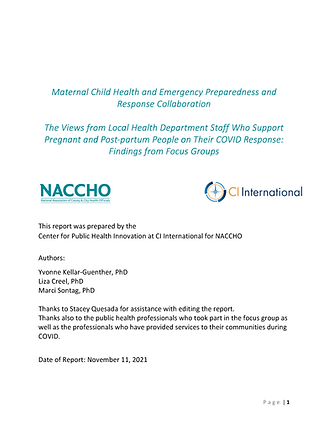
Final Report on Bridging Preparedness and Maternal Child Health
.png)
Bridging Maternal-Child Health, Infectious Disease, Preparedness, and Birth Defects within Cities and Counties
-
Three local health departments (LHDs) selected by NACCHO as demonstration sites participated in a CPHI-facilitated action planning process to strengthen the prioritization of pregnant people and infants in emergency preparedness and response. View NACCHO's one-page summary of this work here.
-
CPHI surveyed and conducted a hotwash with LHD leaders and staff to assess lessons learned from COVID-19, focusing on cross-program collaboration, effective tools and strategies to carry forward, and what is needed to ensure pregnant people and infants have access to support in future pandemics. Access the final report here.

NACCHO One-pager on Work to Prioritize Pregnant People and Infants in Emergency Preparedness and Response

Final Report on Our Hotwash Conducted with Local Public Health Departments
.png)
Sustainability Planning for States' Choose Safe Places for Early Care and Education Programs
CPHI partnered with NACCHO to assess the sustainability needs for states' Choose Safe Places for Early Care and Education (CSPECE) programs. CPHI conducted key informant interviews with state leaders and other key stakeholders to inform the development of a sustainability planning guide and template. In addition, CPHI developed fact sheets for local and state health departments that outline actionable recommendations to enhance collaboration and strengthen the effectiveness of the CSPECE program.

Choose Safe Places Fact Sheet for Local Agencies

Choose Safe Places Fact Sheet for State Agencies
.png)
Working With the National Association of County and City Health Officials to Improve Infant and Child Nutrition in Communities of Color
To identify solutions to best partner with and support BIPOC communities in achieving optimal nutrition in infants and toddlers, CPHI and NACCHO convened three in-person two-day regional meetings and a two-hour online session with national partners. The in-person convenings were designed to understand the facilitators and challenges experienced by public health experts and community agency representatives. Read the final report here.
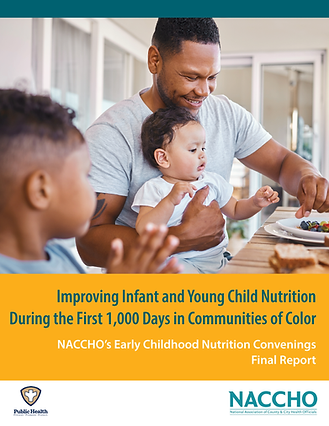
Final Report for CPHI's Work with NACCHO to Improve Infant and Child Nutrition in Communities of Color

Facilitation of the Council of State and Territorial Epidemiologists' Data Modernization Summit
The Council of State and Territorial Epidemiologists - in partnership with the CDC and state, Tribal, local, and territorial partners - convened a Data Modernization Summit in Atlanta, Georgia. CPHI facilitated the two-day summit which included attendees from state, Tribal, local, and Territorial public health agencies. The objectives of the summit were to describe core data functions across the public health ecosystem and identify strategies for implementation and broader scale adoption of the solutions. The final report for this work can be found here.

Final Report from the Data Modernization Summit Facilitated by CPHI